Table of Contents
- How do you have a “church” without God?
- Okay, so what does a typical “service” look like?
- My last church was traumatizing, why should I trust Sunday Assembly to be any different?
- Alright, maybe I’ll come to an assembly, how do I do that?
- Do you do anything else besides the assemblies?
- What the heck is “Congregational Humanism”?
- Does it cost anything to attend or join?
- What resources do you offer?
How do you have a “church” without God?
Between the immense suffering of this world and the newly-found access to vast amounts of scientific information, believing in any god is increasingly difficult for many. However, humans are hardwired to find and participate in communities together – doing so literally adds years to one’s life. It’s important, then, that as our society becomes increasingly secularized that we still gather in communities centered on answering existential questions, developing awe and wonder, and helping others.
That’s what Sunday Assembly is all about! In fact, our motto is, “Live Better, Help Often, Wonder More” for these very reasons.
We’ve also found that the philosophy of Humanism is the perfect ideology to gather around as it melds perfectly with our motto. It is a substantive framework through which we can view the world. Best of all, there is no need for anything supernatural.
Okay, so what does a typical “service” look like?
We call our “service” an “assembly” to be in line with our namesake. Our assemblies will be very familiar to those who were or are Christian as they’re a direct copy/paste from the Anglican church:
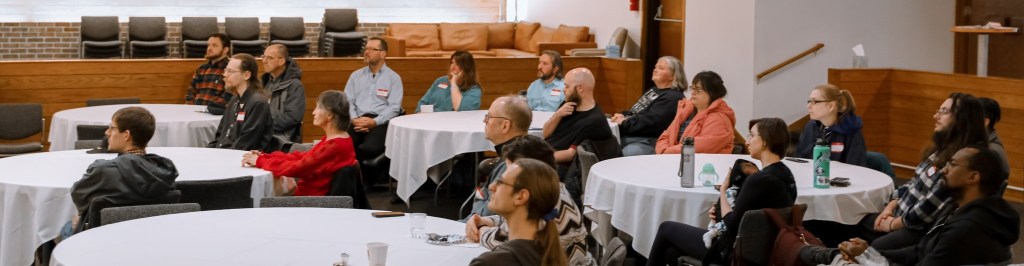
We have a welcoming and gathering statement, sing songs, have an uplifting secular message, sing some more, give some organizational updates, tell people of the upcoming events, then break for lunch which is provided by us.
Of course, for those leaving their childhood or otherwise toxic churches coming back to a space that is too familiar may be unappealing. For this reason we are constantly workshopping the service to make it a more comfortable space for people who’ve been traumatized by their church(es) in the past.
My last church was traumatizing, why should I trust Sunday Assembly to be any different?
We’re incredibly sorry that you’ve has such awful experiences with your past communities. Many of our members have been through similar situations.
Our biggest difference is that our worldview is fundamentally and radically different from all of the Abrahamic religions and most of the other religions. As Humanists, we care more about people and their well-being than any particular text, scripture, or ideology. we don’t believe there is anything called “sin”, and we don’t judge lifestyles unless they actively cause harm to real humans (for example, we disavow racism, sexism, homophobia, transphobia, xenophobia, jingoism, and all economic and governmental systems which keep people poor and oppressed.)
Sunday Assembly Detroit works tirelessly to create a safe space for people considered minorities. For more information on how we handle cases of harassment please see our Code of Conduct page. We will always center and prioritize the needs of the victimized person even if it means removing someone who substantially supports Sunday Assembly Detroit financially and organizationally (such as the president or a large donor). We do not tolerate abuse or harassment from anyone.
Lastly, we support free-thinking and the ability to question everything. We provide resources to improve the “epistemological health” of our members – this means that we review the telltale signs of a cult, we practice spotting fake news, and we are willing to talk about any belief any of us holds and challenge them if they seem incorrect and not in line with scientific consensus. We’re careful to spot conspiracy theories and have an open dialogue with those who believe them. The key is that we all stay sharp to avoid being coerced by pleasant lies and charismatic leaders.
We’re open and willing to change anything we do to make Sunday Assembly a more welcoming space, so feel free to approach anyone in leadership with your ideas. For our leadership’s contact information, visit our Leadership Page.
Alright, maybe I’ll come to an assembly, how do I do that?
Awesome! We typically have our assemblies once a month or less. The best way to find out when the next one is happening is to visit our Meetup Page or Facebook Page. Both of those pages have our most up-to-date list of events.
We meet at The Hawk which is located at:
29995 W 12 Mile Rd, Farmington Hills, MI 48334
The Hawk owns the building and lets us rent from them on Sunday mornings. When you arrive, you can park in the parking lot on the side of the building then enter through the “Fitness” entrance. Follow the signage to the room. We are most likely on the 3rd floor, so take the elevator to your right when you walk in.
Be sure to come hungry and maybe even bring a dish to pass (store bought only) if you’re feeling charitable. There is childcare provided for free so that you can enjoy the assembly without distraction or worry.
See you soon!
Do you do anything else besides the assemblies?
We’re doing stuff all the time! outside of the assemblies, we hold 3-4 events a month. Typically these events are eating out at a restaurant (“Cuisine and Conversation”), a book club, and one rotating event. This rotating event can be anything from field trips to museums to volunteering to watching TED talks over a glass of wine and much more.
The best way to find out what the next event is and when it’s happening is to visit our Meetup Page or Facebook page. both of those pages have our most up-to-date list of events.
See you soon!
What the heck is “Congregational Humanism”?
In short, “Congregational Humanism” is an integration of non-theistic Humanist ethical philosophy with congregational rites and community activities which center on human needs, interests, and abilities.
The term is relatively newer. In the past it was better known as “Ethical Humanism” or “Religious Humanism”, but this new movement is seeking to distance itself from those labels. Congregational Humanism is slightly distinct from Religious Humanism in that its adherents don’t see Humanism as a religion, but instead as an ethical philosophy – much like Secular Humanists do – however, Congregational Humanists still want to create and partake in the rites and community activities that Religious Humanists do.
There’s a lot more to learn about the subject, and the best place to find information is the American Humanist Association. They have a great breakdown of the different types of Humanism and what they mean here:
https://americanhumanist.org/what-is-humanism/edwords-what-is-humanism/
Does it cost anything to attend or join?
You are free to attend every single one of our events without paying money to us – though some of our events require you to pay other organizations such as restaurants and museums. So you can enjoy everything we have to offer for free for your whole life.
With that said, it takes a lot of effort and resources to effectively build a community like this. For a community to grow it has to have attendees, regular financial contributions, and people willing to run the organization. Living in America, we all know that a staple of our society is a church on every streetcorner; Those churches are only there because their members show up and give money. If we want to have a similar presence, then we’ll have to do the same!
So we highly encourage you to become a member and give what you can to help support this community of yours. To learn more about how to join, please visit our prospective membership page.
What resources do you offer?
Besides providing a fulfilling and safe community, we are able to help with performing ceremonies (such as weddings, funerals, baby welcoming / naming ceremonies, etc.), deconstructing your faith, and connecting to other like-minded organizations and mental health resources.
 Detroit